1st Bn The Royal Rifles of Canada
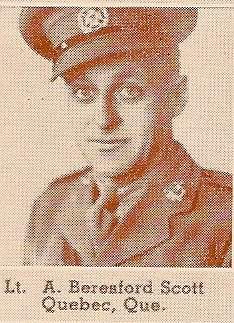
General Information |
||
| Rank: | First Name: | Second Name: |
|---|---|---|
| Lieutenant | Arthur | Beresford |
| From: | Enlistment Region: | Date of Birth (y-m-d): |
| Preston Park QC | Eastern Quebec | 1906-01-17 |
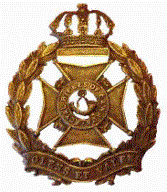
Transportation - Home Base to Hong Kong
Members of 'C' Force from the East travelled across Canada by CNR troop train, picking up reinforcements enroute. Stops included Valcartier, Montreal, Ottawa, Armstrong ON, Capreol ON, Winnipeg, Melville SK, Saskatoon, Edmonton, Jasper, and Vancouver, arriving in Vancouver on Oct 27 at 0800 hrs.
The Winnipeg Grenadiers and the local soldiers that were with Brigade Headquarters from Winnipeg to BC travelled on a CPR train to Vancouver.
All members embarked from Vancouver on the ships AWATEA and PRINCE ROBERT. AWATEA was a New Zealand Liner and the PRINCE ROBERT was a converted cruiser. "C" Company of the Rifles was assigned to the PRINCE ROBERT, everyone else boarded the AWATEA. The ships sailed from Vancouver on Oct 27th and arrived in Hong Kong on November 16th, having made brief stops enroute at Honolulu and Manila.
Equipment earmarked for 'C' Force use was loaded on the ship DON JOSE, but would never reach Hong Kong as it was rerouted to Manila when hostilities commenced.
On arrival, all troops were quartered at Nanking Barracks, Sham Shui Po Camp, in Kowloon.
Battle Information
Killed in action at Stanley Mound. For a detailed description of the battle from a Canadian perspective, visit Canadian Participation in the Defense of Hong Kong (published by the Historical Section, Canadian Military Headquarters).
Decorations Received
| Image | Name of Award | Abbreviation | References | Precedence | Comments |
|---|---|---|---|---|---|
 | Mentioned-in-Despatches | MiD | 37, 38, 123 | 13 | Citation not found |
Other Military or Public Service
No other or additional related information found. Please submit documents to us using the contact link at the top of this page.
Death and Cemetery Information
| Date of Death (y-m-d) | Cause of Death | Death Class | |
|---|---|---|---|
| 1941-12-24 | Killed In Action | ||
| Cemetery Location | Cemetery | Grave Number | Gravestone Marker |
| Cape Collinson Road Chai Wan Hong Kong China | Sai Wan Memorial | Column 23. | CWGC |
Gravestone Image


Obituary / Life Story
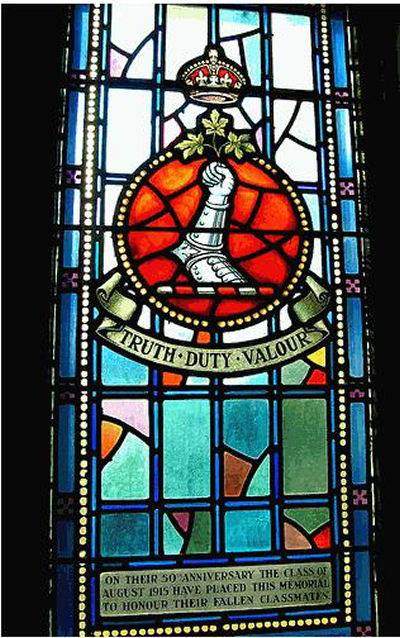
Arthur Scott - Stained Glass Window - Ex-cadets are named on the Memorial Arch at the Royal Military College of Canada in Kingston, Ontario and in memorial stained glass windows to fallen comrades. 1817 Lt Arthur Beresford Scott (RMC 1925) was the son of Mr. and Mrs. Arthur E. Scott. He was the husband of Marjorie E. Scott (nee Smith), of Quebec City, Quebec. He served with the Royal Rifles of Canada, R.C.I.C. He was Mentioned in Despatches. He died on Dec 24, 1941. His name is listed on column 23 of the Sai Wan Memorial in Victoria, Hong Kong.
This SAI WAN MEMORIAL honours over 2000 men of the land forces of the British Commonwealth and Empire who died in the defence of Hong Kong during the Second World War. The SAI WAN MEMORIAL is in the form of a shelter building 24 metres long and 5.5 metres wide. It stands at the entrance to Sai Wan Bay War Cemetery, outside Victoria, the capital of Hong Kong. From the semi-circular forecourt, two wide openings lead to the interior of the building. The names are inscribed on panels of Portland stone. The dedicatory inscription reads:
1939 - 1945 The officers and men whose memory is honoured here died in the defence of Hong Kong in December 1941 and in the ensuing years of captivity and have no known grave.
The northern side of the Memorial is open and four granite piers support the copper roof. From a commanding position 305 metres above sea level, it looks out over the War Cemetery where some 1,500 men lie buried, and across the water to Mainland China - a magnificent view of sea and mountains.
General Comments
The family headstone is found at Mount Hermon Cemetery, Sillery, Quebec, Canada.
Received in April 2023 from Lyn Scott: Please note that Lt. Scott’s wife Marjorie’s maiden name was Swift, not Smith as mentioned in his obit. He also left behind a son, Michael Beresford Scott (1936 - 2020).
EVERY DAY FOR 60 YEARS, 'FLASH' REMEMBERS HIS HERO
When Robert John "Flash" Clayton woke up one December day in 1941, he realized he had been left for dead. A hand grenade had exploded between his feet and, in one of those whims of war, it hadn't done fatal damage, but chewed up his legs and knocked him cold.
It was during the Japanese invasion of Hong Kong. He could hear the sounds of battle and could see the advancing enemy. He primed one of his own hand grenades and threw away the safety pin. Holding the trigger closed, he planned to become a booby trap. Certain he was about to be bayoneted, he figured when death loosened his grip on the grenade, he could maybe take his killer with him. A lieutenant from his regiment, the Royal Rifles of Canada, suddenly appeared. He had come back to see if it was true that Sgt. Clayton was dead. They threw away the live grenade. Its blast was hardly noticed in the din. The officer lifted the wounded man onto his back, and ran back to the new defensive line.
"While I was on his back and thanking him, he said to forget it. His line is burned into my memory. 'We'll have a drink on it someday.""
After rescuing the sergeant, the lieutenant joined the effort to set up a defensive line at Repulse Bay. The unstoppable Japanese invasion force rolled over that weak line a few days later. Says Mr. Clayton, his rescuer was found dead. Bayoneted. "His hands were tied behind his back. He didn't die in battle. He was murdered."
At the National War Memorial on Nov. 11, Flash Clayton, 83, of Brechin, Ont., will be part of the official party and will lay a wreath for the 550 Canadians who died in the hopeless defence of Hong Kong. Half of them died during the 44 months it took to end the war. They were victims of brutal conditions in slave labour camps.
Flash Clayton will be remembering. He can't forget. He said this week: "I don't think ever a day has gone by that I haven't thought about the man who saved my life. He was a hand some bugger. From Quebec City. Married and had children." Nor can he forget the hundreds of prisoners he watched die in Japanese labour camps. Post-war investigations showed the death rate in German prisoner of war camps was four per cent. In Japanese camps, it was 27 per cent.
But the old soldier's memory is sharper every Nov. 11 as, like most veterans, he focuses. "It's the same at Christmas. I wake up every Christmas morning in St. Stephens College Hospital in Hong Kong." He wakes up in the world of memory, and he was there when Japanese soldiers killed most of the wounded with bayonets. Again he was lucky. He managed to hide.
The hospital story will be featured on the History Channel Nov. 8, as part of a three-night special presentation leading up to Remembrance Day.
It's part of a series called For King and Country, hosted by Norm Christie.
The horrors suffered by the Hong Kong vets as prisoners is little understood by most Canadians. Like most of those who survived, Flash walked out of captivity weighing 100 pounds. It took five months in hospital in Canada to gain enough weight that he felt he didn't frighten people. Of those who returned, 87 were legally blind, their site
lost to lack of vitamins. "A lot of us didn't live to age 50."
In 1941, there were 1975 Canadians on garrison duty at Hong Kong. Mr. Clayton is one of only 180 still alive.
His hands will be laying a wreath at the National War Memorial, but his thoughts will be at Sai Wan Bay Cemetery in Hong Kong, where 2,071 names of those who died trying to defend the colony are carved on stone panels. There are 283 Canadians among them and, of those, 107 are unidentified.
On column 23 is a panel bearing the name of the man who will be most remembered as Flash Clayton lays his wreath in Ottawa - Lieut. Arthur Beresford Scott of Quebec City.
Mr. Clayton recovered and got a job with the City of Toronto, married and raised two daughters. His wife, Jessica, will be with him at the ceremony. Says Mr. Clayton: "I've had a wonderful life and I enjoy every day. Had it not been for Lieut. Scott, my life would have ended 63 years ago."
"After the formalities, I'll have a drink and toast him. I always do."
E-mail Dave Brown at dbrown000@sympatico.ca
Unsourced Newspaper article written by Dave Brown, 2004
Links and Other Resources
There may be more information on this individual available elsewhere on our web sites - please use the search tool found in the upper right corner of this page to view sources.
Related documentation
Our HKVCA Vault (Google Docs) may contain additional information, newspaper clippings, and documents which have been saved for this soldier. To access this information, note the soldier's service number shown at the top of this page, then use the letter prefix to select the corresponding link below. A Google Docs folder list will open in a separate tab. Search for the file identified by the service number to access any additional information we may have acquired.
- Service Number Prefix: A to G
- Service Number Prefix: H to P
- Service Number Prefix: X (Officers)
Facebook has proven to be a valuable resource in the documentation of 'C' Force members. The following link will take you to search results for this soldier based on his regimental number, but they may be incomplete.
Facebook Search Results.
To capture all items for an individual, we recommend visiting our Group: Hong Kong Veterans Tribute of Canada and using the search option there. Note: results may be contained within another related record.
Find a Grave® is a valuable resource that may contain additional information on this 'C' Force member. When you arrive at the site search page, fill in as much detail as you can for best results.
End of Report.
Report generated: 18 Sep 2026.
Additional Notes
(These will not be visible on the printed copy)
NOTE: This report layout has been updated as of September 2026. Some data previously displayed could not be validated and has been removed. Removed data includes: Appointment, Company, Platoon, Wounded Information, and Hospital Visits. If it exists, information on these items may be found in our Vault.
- Service numbers for officers ("X") are locally generated for reporting only. During World War II officers were not allocated service numbers until 1945.
- 'C' Force soldiers who died overseas are memorialized in the Books of Remembrance and the Canadian Virtual War Memorial, both sponsored by Veterans Affairs Canada. Please use the search utility at VAC to assist you.
- Some birthdates and deathdates display as follows: 1918-00-00. In general, this indicates that we know the year but not the month or day.
- Our POW camp links along with our References link (near the bottom of the 'C' Force home page) are designed to give you a starting point for your research. There were many camps with many name changes. The best resource for all POW camps in Japan is the Roger Mansell Center for Research site.
- In most cases the rank displayed was the rank held before hostilities. Some veterans were promoted at some point prior to eventual post-war release from the army back in Canada. When notified of these changes we'll update the individual's record.
- Images displayed on the web page are small, but in many cases the actual image is larger. Hover over any image and you will see a popup if a larger version is available. You can also right-click on some images and select the option to view the image separately. Not all images have larger versions. Contact us to confirm whether a large copy of an image in which you are interested exists.
- The 'From' information box at the top of the report represents the enlistment location unless we have obtained updated information pinpointing where the member lived.
- In some cases the References displayed as part of this report generate questions because there is no indication of their meaning. They were inherited with the original database, and currently we do not know what the source is. We hope to solve this problem in future.
- We have done our best to avoid errors and omissions, but if you find any issues with this report, either in accuracy, completeness or layout, please contact us using the link at the top of this page.
- Photos are welcome! If a photo exists for a 'C' Force member that we have not included, or if you have a higher quality copy, please let us know by using the Contact Us link at the top of this page. We will then reply, providing instructions on submitting it.